

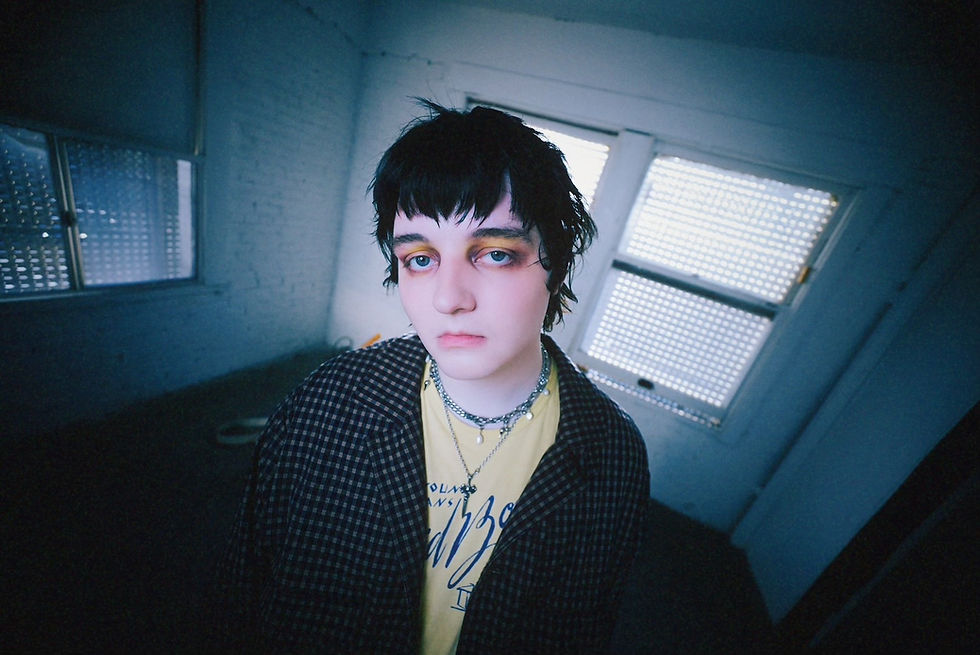
COVER - Pool Kids: "We’ve never had someone telling us what kind of record to make. It’s always been self‑led. "
There’s a particular kind of spirit that comes from starting in the places most bands only romanticise in hindsight, like the house shows, the backyards, the strangers’ floors that blur together by week three on the road. Formed in Tallahassee, Florida, and best known for their candid songwriting, intricate guitar work, and a rise shaped by the DIY scene, POOL KIDS didn’t just dip their toes into that world; they built themselves from it.
When they talk about the years gone by, it’s with the clarity of people who understand exactly how much those times shaped the band they’ve become. With vocals and guitar from Christine Goodwyne (who is also the primary songwriter for the band), guitar from Andy Anaya, bass from Nicolette Alvarez and drums from Caden Clinton, POOL KIDS are a band on a journey. We caught up with Christine and Nicolette to see what the band is really about.

Christine remembers those early years as a kind of crash course in everything the industry doesn’t teach you. “Roughing it for so many years taught us everything that's important to being in a band - proper show etiquette, how to be a good opener, how to behave when you’re the local band on a bill,” she says. “It gave us a deeper appreciation for the whole thing.” Nicolette agrees, adding her own version of the same truth, “We used to sleep on strangers’ floors for weeks. We don’t have to drive around in my minivan anymore. It’s added to this belief in the project, like, we started there, and now we’re here, so let’s keep going.”
That sense of slow but earned momentum is woven through Easier Said Than Done. The band recorded over five intense weeks in Seattle, and the album was entirely self‑funded. It would be easy to spin the romantic version of that story: a band holed up in a studio, chasing inspiration. However, the reality was far less glamorous, admits Christine. “It added a very tangible level of stress and discomfort. We didn’t have a home base, and it took a toll on our mental health. But it shows how much we prioritise this, maybe to an unhealthy degree.” And yet, even in the exhaustion, there was freedom. “We’ve never had someone telling us what kind of record to make,” Nicolette says. “It’s always been self‑led. DIY taught us that you can do it. We went in feeling empowered. Exhausted, but empowered.”

Control, it turns out, is the one thing they’ve never been willing to hand over. Even signing to Epitaph, a milestone that could have easily shifted the balance, happened on their terms. “The patience was huge,” Christine says. “They came to shows, even in Japan, and some of them were in the pit. They passed the vibe check.” Nicolette puts it more bluntly. “Other labels made it feel like we should be grateful they looked at us for five minutes. We were always being told what they thought we wanted to hear. Epitaph showed they were excited and felt lucky to work with us; they checked off the boxes on the list of what we were looking for, too.” POOL KIDS have clearly found the right label for them, a team that’s both dedicated and genuinely invested.
If there was a moment that cracked open the sense of what was possible, though, it came from outside the label pipeline entirely. It came from someone who hardly needs an introduction: Hayley Williams. “It was the best thing that could’ve happened,” Christine says, still sounding a little stunned. “And it wasn’t just ‘check out this band.’ It was ‘PARAMORE wished we sounded like this.’ Absolutely mind‑blowing.” The impact was immediate and surreal. “Our Spotify listeners flipped overnight — it was 60% male listeners, 40% female, but then inverted. We woke up, and it was like 60% female, 40% male - which was great!”
That shift toward a more visibly queer, more visibly femme audience mirrors the band’s own relationship to representation. Their Vanity Fair profile touched on it, but Christine expands on the idea with a kind of quiet conviction. “You know on paper that it’s not just white men who can do rock,” she says. “But then why didn’t I start a band until college? Because that’s when I first saw women in smaller bands touring. It’s important to see people other than white men doing the things you want to do.”
That visibility threads into the songwriting, too. Not Too Late, one of the album’s most emotionally raw tracks, dives into OCD and reassurance‑seeking with a level of candour that borders on uncomfortable — until Christine explains how it happened. “I don’t think I had a choice,” she says. “The lyric ideas came, so that’s the song I wrote. It felt weird releasing it, but our lyrics have always been personal. DIY helped with that; my first time playing a song in a house, everyone was just like, ‘Yeah, sounds great.’ From the beginning, it felt comfortable.”
Comfort, though, is not the point of the year ahead. POOL KIDS are stepping onto stages that demand something different — Outbreak Fest, 2000 Trees — festivals known for passionate crowds, eclectic lineups, and the kind of energy that can either swallow a band whole or launch them into a new orbit. Christine admits she was nervous at first. “I thought I’d hate feeling far from the crowd, but it’s amazing. You can see everyone so clearly. And festivals make me think more about designing our sets, like walk‑ons, transitions, all of it. Outdoor daytime shows are actually very fun.” Nicolette sees festivals as a challenge in the most affectionate way. “Most people watching probably don’t know who we are. Can we win over a cold crowd? I love that. It feels like a test.”
Outbreak, in particular, feels like a homecoming of sorts, perhaps not geographically, but certainly spiritually. “We can’t really justify playing house shows anymore,” Christine says. “So it’s hard to keep that ethos alive. Festivals like Outbreak feel like a way to still tap into it.” Nicolette lights up at the mention of it. “Every year we watch the sets online, from TURNSTILE to SCOWL. It’s cool to see a festival focused on showcasing these overlapping niches and doing it so well.” They’re hoping to catch PUP, THE FRONT BOTTOMS, SNAIL MAIL and GREET DEATH, who POOL KIDS played house shows with to ten people in Michigan back in the early days. It’s a lineup that mirrors their own trajectory - bands who built something slowly, stubbornly, and with a sense of community that never really leaves you.


As for what comes next, Christine is letting instinct lead. “I kind of feel like I don’t have a choice in what ideas come to me,” she says. “I might try to be slightly less verbose as a fun challenge, find more succinct ways of explaining feelings instead of over-explaining. But if it doesn’t work out, whatever. That’s kind of our thing at this point.”
And maybe that’s the real through‑line of POOL KIDS: the refusal to force anything. The willingness to sleep on floors if that’s what the art requires. The freedom to follow the song wherever it goes. The belief, earned, not assumed, that they can keep climbing because they’ve already survived the hardest parts. They may have started in basements, but their ascent hasn’t stalled for a moment and shows no sign of doing so anytime soon.
Words: Lou Viner-Flood
Photos (Live and Posed): Lizzie Jones for Out Of Rage
Cover Design: Robert Halls
Art Assistance: Spencer Cunningham
Editorial Lead: Amber Brooks
With Thanks To: Mitch Stevens and Revenant Earth


Comments