

REVIEW: Behemoth - I, Scvlptor
- Lysandre Pons
- 11 hours ago
- 6 min read
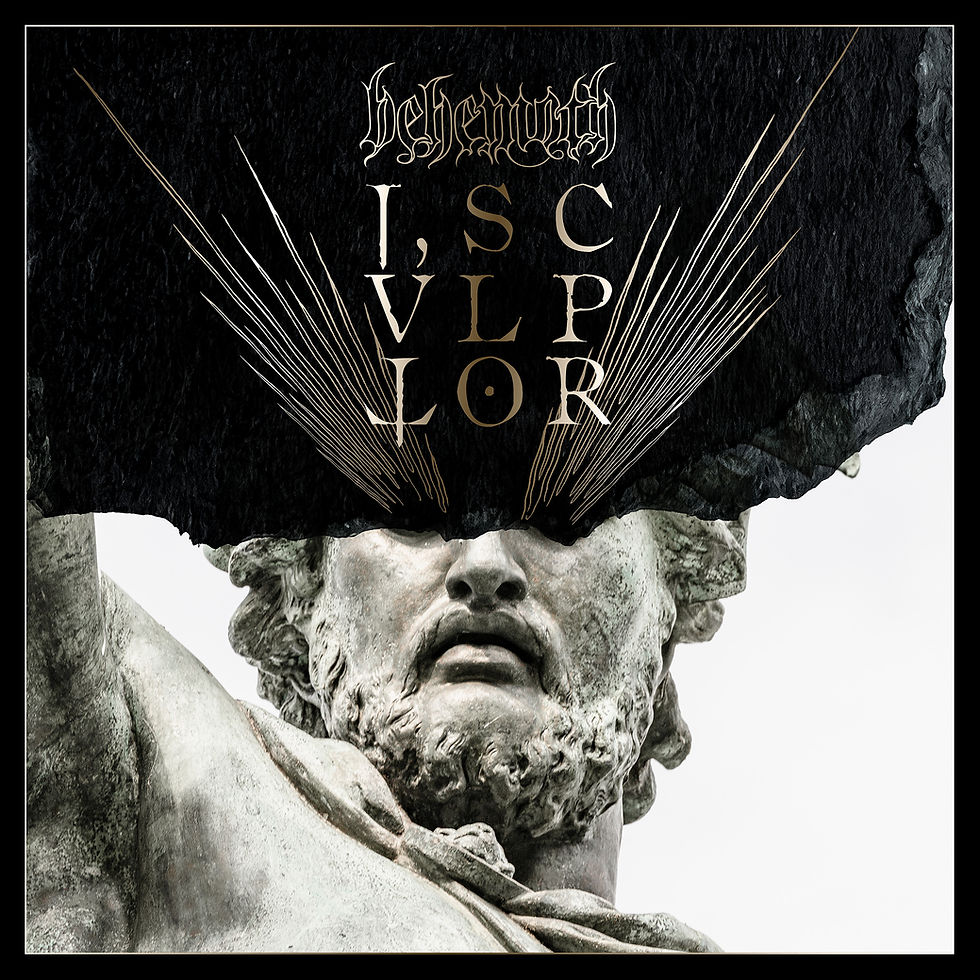
There are few bands in extreme metal with the ability to make the past feel as immediate as BEHEMOTH. With I, Scvlptor, the Polish legends revisit their roots, reshape familiar material and push into new territory, creating a release that feels less like a conventional stopgap and more like a statement of becoming. Due for release on September 4th, the opus contains eight previously unreleased tracks: seven studio recordings and one live performance. Rather than releasing a traditional studio album, we’re offered a cabinet of curiosities of sorts. It features handpicked peeks at BEHEMOTH's identity, connecting the band's formative years with the immense, uncompromising force of its present day form.
The title track, I, Scvlptor, is a grandiose opener built like a centrepiece. With a slower build-up adding layers of dark atmosphere, it carries the kind of epic weight that has become synonymous with BEHEMOTH while refusing to simply repeat the formulas of the past. As Nergal explains, the song is “rooted in the tradition of monumental tracks like O Father O Satan O Sun!, Lucifer or Nieboga Czarny Xiądz, while at the same time opening a new chapter.” The song's concept is described as “a metaphor for the endless process of shaping oneself”. However, the song goes beyond nihilism, it puts an emphasis on the battle to move forward and it musically sounds like one. Horns emerge first, surrounded by distorted, dark electronics that immediately establish an eerie atmosphere. Then the drums and strings arrive, gradually laying the foundations for something increasingly heavy, as if the listener is being pulled deeper and deeper into a dark tunnel. When Nergal's voice enters, it is strong and commanding, leading an army into battle. The track repeatedly seems to widen, becoming less an individual performance and more a call for others to join the march. It reminds the listener that this is going to be more adventurous than a simple collection of archival material.
Lord ov the Horizons immediately shifts gear. It surprises us with a considerably more melodic approach, driven by a gothic-sounding guitar and lyrical singing before suddenly turning into vicious black-metal screams. Vocally, this is one of the most interesting tracks on the release. It moves through a surprisingly wide range of approaches, switching between more traditional singing and harsher screams without making the transitions feel forced. The drums also alter the pace between slower parts and others that are bullet-like in speed. The guitars are also given room to shine, with solos that can be appreciated rather than simply being buried underneath the overall assault. It gives the song a dynamism that feels experimental without abandoning its roots. It declares that the band is not afraid of pushing themselves and try something different. The track has an overall well-distributed composition with enough variation to remain unpredictable, and it hints at directions the band could explore further in the future.
Rise of the Blackstorm of Evil stands as the longest song and is a blast from the past. It is one of the most important pieces in terms of connecting the band's past and present. Originally written in 1992, the song reflects the influence of acts such as SAMAEL, CELTIC FROST and HELLHAMMER. This new recording keeps the original structure but gives the guitars some sophisticated polish, reworking them into two interlocking layers, while the lyrics have also been slightly revised. The difference is a much tighter and sharper performance than the one heard on The Return of the Northern Moon. Yet the song's original spirit remains intact, which is ultimately what makes the re-recording worthwhile. Its position also makes sense within this opus. After the more experimental track, this one brings the last two back together with commanding vocals and a more rhythmically varied sound, giving the release a broader sense of movement. At some points though, the voice seems to disappear slightly behind the instruments and has a harder time keeping us hooked.

If Rise of the Blackstorm of Evil allows the listener to wander, In Thy Pandemaeternum grabs them by the collar and doesn't let go. Hectic and aggressive from the first seconds, it wastes no time establishing itself as arguably the heaviest track here. Everything feels extremely tight, with the guitars, drums and vocals working together as one rather than competing for attention. Despite its length, the second longest track, it somehow feels short. There is so much happening that the track seems to race past, maintaining its intensity without becoming monotonous. There is also a distinctly theatrical quality to the arrangement, particularly during the “let them feast” chant before a sharp guitar solo. It is one of those moments that would make you buy a live show ticket, crossing fingers that this makes it on the setlist. Originally featured on 1998's Pandemonic Incantations, this is the second early BEHEMOTH track to receive a revamp. The arrangement remains largely familiar, but the production makes a considerable difference. What once fought for space within the dense original mix now emerges with much greater definition.
We scored a wild card with Begotten. It introduces yet another nuance to the record. Its drums and guitars almost feel like 1980s heavy and gothic metal before the song accelerates, creating a completely different atmosphere. This mixes old with new, as it was written during the sessions for The Shit Ov God but was ultimately left off the album because the band felt it didn't fit with the other material at the time. It first appeared on the Metal Hammer exclusive Vnholy Psalms and is now given a chance for a much wider scene. It still doesn't slot perfectly into this record, but it doesn't necessarily need to. It feels like a deliberate interruption, another piece of BEHEMOTH's journey that has been given a home. Its atmosphere remains dark and commanding, but the way it gets there is sufficiently different to make it one of the more intriguing inclusions.
The decision to include a cover of VENOM's In League With Satan feels like not only looking at the band’s past but also its influences and roots. And that turns into one of the most memorable moments on I, Scvlptor. The drums and bass are particularly catchy, working with the guitar hand in hand, building layers of sonic violence. There is a strong unity and community feel to the song. Like it is meant to be sung collectively, gathered in some enormous hall after a battle. We can easily see this becoming a live favourite, bringing fans together. Shagrath of DIMMU BORGIR makes a guest appearance, reinforcing this gathering of forces.
Where the previous song brings some of the most important influences in the studio, The Return of Darkness and Evil does it on stage. This BATHORY cover is anchored to the crowd and place, reminding everyone that the band is a force to be reckoned with live. I keeps bringing peoples together with Sakis Tolis of ROTTING CHRIST joining them live in Athens. After so much carefully controlled studio production, hearing the band in a raw and electric setting is a refresher we didn’t know we needed.
Closing with a second version of Lord ov the Horizons is perhaps the most unusual choice on the record. The rough mix offers a glimpse into what happens between recording a song and arriving at the finished version. It isn't a radically different interpretation, nor does it sound like a primitive demo. Most of the key elements are already there. What changes is the balance. There is less clarity and refinement than in the final version. For some, the differences may not be substantial enough to completely justify including two versions of the same song on an eight-track release. But it does bring an interesting perspective and reflection on the album itself now that it’s almost over. It already makes it a new past to be reinvented.
I, Scvlptor works because it could have been disjointed but isn’t. It is unconventional but assumed as such. Nergal describes it as “more of a compilation”, while also insisting that the fact it contains songs nobody has heard before makes it “a significant release” for the band. There are moments when the record feels voluntarily (or not) fragmented. But the contrasts are also what give it personality. Like the sculptor in the title track, BEHEMOTH are still working on themselves. They are taking familiar forms, breaking them apart, sharpening some edges, exposing others and occasionally revealing something entirely unexpected underneath. The final shape isn't necessarily the point but the act of sculpting is.
Score: 7/10
I, Scvlptor will be released on 4th September 2026 via Nuclear Blast Records.
Words: Lysandre Pons
Photos: Grzegorz Gołębiowski


Comments